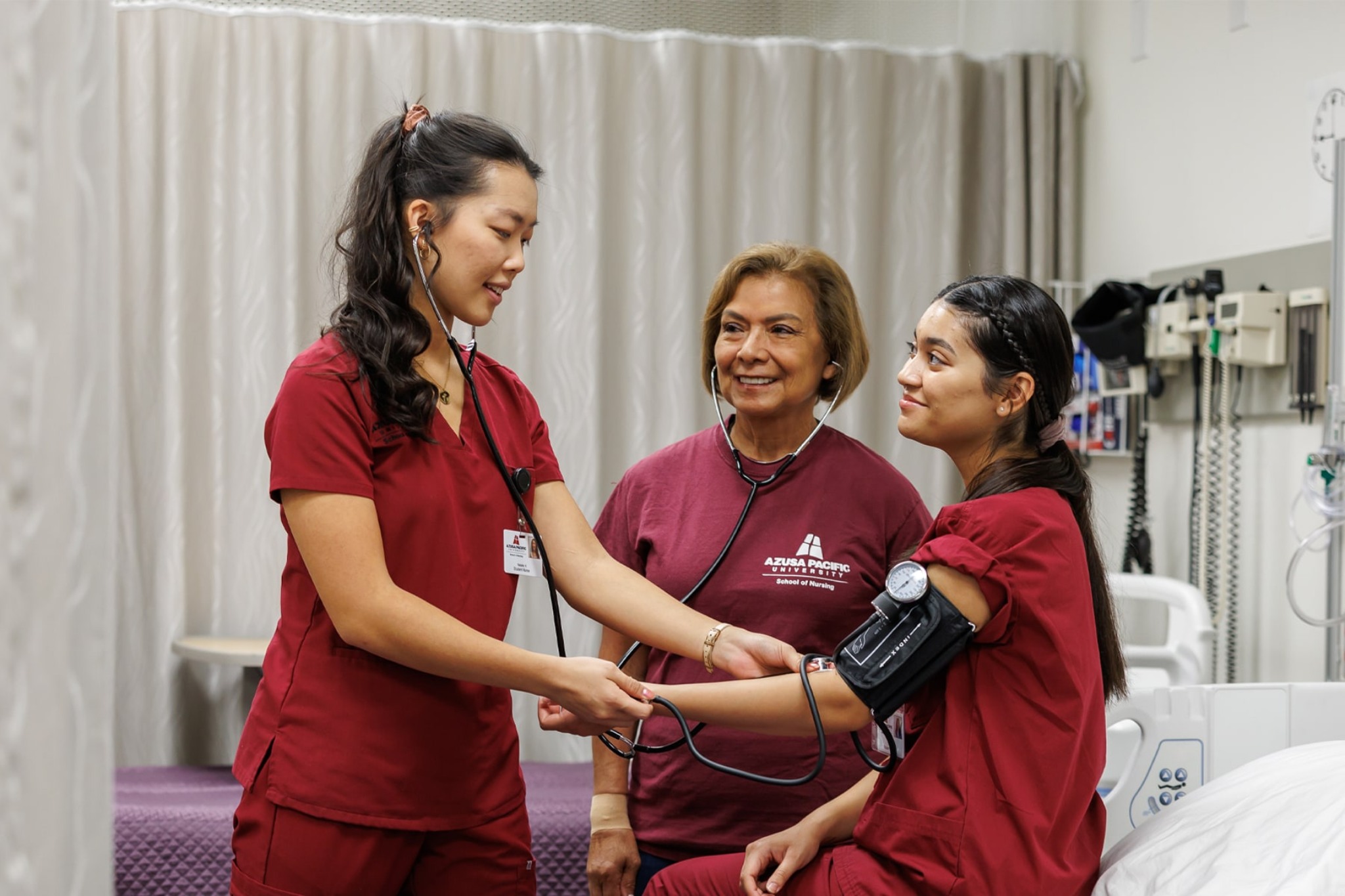
Entry-Level Master’s in Nursing (ELM)
Program at a Glance
Upcoming Events
Pre-Recorded Entry-Level Master’s Webinar
Info Meeting | Entry-Level Master’s in Nursing (Monrovia)
- Monday, June 15, 2026, 6-7:30 p.m.
Info Meeting | Entry-Level Master’s in Nursing (San Diego)
- Tuesday, June 16, 2026, 5-6:30 p.m.
Application Deadlines
- Spring Semester: September 15
- Summer Semester: January 15
- Fall Semester: May 15
Program Information
- Program Units: 106-125
- Cost per Unit: $895
- Cost Breakdown:
- Prelicensure/BSN: $61,755
- Postlicensure/MSN: $33,115-$50,120
- Work as a nurse, and pay as you go
- Total estimated cost: $94,870-$111,875
Location
- Inland Empire, Monrovia, San Diego

You’re Joining One of SoCal’s Most Distinctive Nursing Programs

APU Ranked Among Best Grad Schools by Money
Azusa Pacific University was ranked in Money’s Best Graduate School Programs 2025 for education and nursing, focusing on affordability, value, and return on investment.

Earn an Entry-Level Master of Science in Nursing (ELM) Degree at Azusa Pacific University
You’ll graduate prepared to enter professional nursing and advanced practice roles. We’ll help you open doors in the medical field and graduate ready to pass the NCLEX licensure examination to become an RN, gain qualifications to apply to the State of California for certification as a clinical nurse specialist and/or nurse practitioner, and obtain eligibility for the Public Health Nursing Certificate. You’ll gain firsthand experience during your clinical residency, equipping you for success in your nursing career. This program is designed for students who hold baccalaureate or higher degrees in other disciplines, and students can choose from a variety of specialty tracks.

Gain Hands-on Experience
- Provide hospital care for diverse groups, the underserved, the poor, and the homeless during clinicals.
- Receive personalized attention in a supportive Christian environment.
- Learn from faculty experienced in the nursing field.
- Build the knowledge and experience needed to pass the NCLEX exam.
By the Numbers
Get Started
I was in the ICU, the NICU, the neuro ICU, the operating room, the pediatric operating room, the oncology ward, the hematology ward, a med-surg unit, a postop unit, a postacute unit, a rehab unit, a nursing home, hospice care, home health care, and worked in community health. Our faculty...gave us chances to experience all these types of nursing.Leonard Ko ’25
Program Details
The Entry-Level Master of Science in Nursing is an accelerated graduate nursing program designed for students who desire to enter the nursing profession and hold a baccalaureate or higher degree in other disciplines. During their first four semesters, admitted students complete all prelicensure courses (theoretical and clinical) in an accelerated format, as well as selected graduate nursing courses, followed by a clinical residency, in preparation for the RN licensure examination. Students then continue with courses and preparation leading to a Master of Science in Nursing (MSN).
Browse the tabs below—if you have questions, visit the Student Services Center page, and we’ll make sure you get the info you need.
Which of my courses will count as ELM program prerequisites?
The prerequisites will generally fit the following guidelines:
- Human Anatomy and lab (4 semester units): May also be titled “Intro to Anatomy”
- Human Physiology and lab (4 semester units): May also be titled “Intro to Physiology.” You can also take “Human Anatomy and Physiology” but it must be both parts for a total of 8 semester units. Both parts must come from the same university/college.
- Organic Chemistry and lab (3 semester units): The course description should explicity state that organic chemistry is covered, so many “General Chemistry” classes will not fulfill this requirement (and in fact are often prerequisites for organic and biochemistry classes).
- Biochemistry (1 semester unit): You can take a full biochemistry class (generally worth 3 to 5 units), or you may combine this prerequisite course with the Organic Chemistry class. If combined, the Organic Chemistry class must be worth 4 semester units, and the course description needs to explicitly state that biochemistry is covered.
- Microbiology and lab (4 semester units): Acceptable courses are usually titled “Microbiology,” “General Microbiology,” or “Intro to Microbiology.”
- Verbal Communication Skills (3 semester units): Acceptable courses are usually titled “Public Communication,” “Speech 101,” or “Intro to Public Speaking.” The course description must explicitly state that students regularly practice public speaking in front of the class. Many communication courses that do not involve frequent public speaking, such as “Interpersonal Communication” or “History of Mass Communication,” will not fulfill this requirement.
- Written Communication Skills (3 semester units): Acceptable courses are usually titled “Freshman Writing Seminar” or “Intro to Composition.” A literature class will not fulfill this requirement. AP English scores from high school that were used as transfer units for your bachelor's degree may complete this requirement.
- General Psychology (3 semester units): May also be titled “Intro to Psychology.” We are looking for a broad foundation in psychology, so specific courses like “Abnormal Psych” or “Psychology of Sexuality” will not fulfill this requirement. AP Psychology scores from high school that were used as transfer units for your bachelor's degree may complete this requirement.
- Human Growth and Development (3 semester units): If your college does not offer a class titled “Human Growth and Development,” it is probably called “Lifespan.” “Developmental Psychology” may fulfill the requirement if the course description explicitly states that the entire lifespan is covered. Classes that focus on one piece of the lifespan, such as “Child Psychology” or “The Psychology of Aging” will not fulfill this requirement. “Sociology of Life” classes will not fulfill this requirement.
- Statistics (3 semester units): We can accept a field-specific statistics class. AP Statistic scores from high school that were used as transfer units for your bachelor’s degree may complete this requirement.
- Research Methods (3 semester units): This class will usually be found in the behavioral science department, such as “Research Methods in Psychology” or “Research Methods in Sociology.” The course description must explicitly state that the ethics of research are discussed and that the research methodologies are covered. Experimental methods or bench research courses do not fulfill this requirement.
After studying the list, if you have questions about your prerequisite courses and whether they will count toward your ELM, refer to our Transfer Guidelines.
Remember, your application for the ELM program cannot be moved forward for admission consideration until you have completed all prerequisite courses.
Admission Requirements—Domestic Applicants
The university graduate and program admission requirements below must be met before an application is considered complete.
Students must first apply and be admitted to graduate status at the university before being considered for admission to the School of Nursing graduate programs, including ELM and Master of Science in Nursing (MSN).
- Graduate application for admission
- $45 nonrefundable application fee
- Official transcripts from all institutions leading to and awarding the applicant’s bachelor’s degree from
a regionally accredited institution and all postbaccalaureate study
An official transcript is one that Azusa Pacific University receives unopened in an envelope sealed by the former institution and that bears the official seal of the college or university. A cumulative minimum 3.0 (on a 4.0 scale) grade-point average on the posted degree is required for regular admission status. Provisional admittance may be granted to individuals with a lower GPA if competency can be shown through multiple measures.
Transcripts should show completion of prerequisite courses (in expected semester units):
- Sciences: human anatomy and lab (4 units), human physiology and lab (4 units), biochemistry (1 unit), organic chemistry and lab (3 units), general microbiology and lab (4 units) (Biochemistry and organic chemistry may be combined in one 4-unit class.)
- Nonsciences: communication skills—verbal (3 units) and written (3 units), general psychology (3 units), human growth and development (lifespan) (3 units), statistics (3 units), and a research methods course in any behavioral science field (3 units)
- Successfully complete prerequisite requirements including General Microbiology with lab (4 units); Human Anatomy with lab (4 units); Human Physiology with lab (4 units); and General, Organic, and Biological Chemistry for the Health Sciences (4 units) with no lower than an overall 3.0 (B) grade-point average.
- If you have questions regarding specific prerequisite courses, please refer to the Frequently Asked Questions tab below .
Any applicant submitting international (non-U.S.) transcripts must submit both an official, comprehensive transcript evaluation report from one of APU’s approved agencies (list is available from Graduate and Professional Admissions) and a copy of the international transcripts themselves (translated into English, if necessary).
- Two recommendations, from professional or academic (work or school) sources, submitted through the online application
- A personal statement no longer than 2-3 pages (double-spaced). This statement should include attention
to each of the following:
- Why you are applying to the Azusa Pacific University ELM program.
- Your motivations for pursuing nursing at this time in your life, including relevant background experiences and why you are choosing nursing over other healthcare professions.
- Any professional or volunteer experiences you have related to nursing.
- Brief background information which would help someone get to know you as a unique person.
- Brief discussion of professional goals.
- Résumé or statement of experience
- For applicants who are U.S. permanent residents, submit a photocopy of your green card. If you have applied for a green card but have not yet received it, you will need to apply through APU’s International Center. Please see “Admission Requirements—International Applicants” below.
Send official transcripts to:
Office of Graduate and Professional AdmissionsAzusa Pacific University
PO Box 7000
Azusa, CA 91702-7000
[email protected]
Application Deadlines
Note that all deadlines refer to the date Graduate and Professional Admissions receives your complete application package. This is not a postmark deadline.
Deadlines
- Spring Semester: September 15
- Summer Semester: January 15
- Fall Semester: May 15
Admitted students will be required to submit a $500 nonrefundable admissions deposit within a week to hold their spot in the cohort.
Admission Requirements—International Applicants
Azusa Pacific University is authorized under federal law by the U.S. Citizen and Immigration Services and the U.S. Department of State to enroll nonimmigrant, alien undergraduate and graduate students. APU issues and administers both the I-20 and DS 2019 (F-1 and J-1 status documents respectively).
To apply for a graduate program at APU, the following requirements must be fulfilled in addition to meeting the domestic applicant and program-specific admission requirements specified above.
International applicants must also:
- Demonstrate proficiency in English through a placement test with the Academic Success Center, or through a TOEFL/IELTS score that meets program-specific requirements. Refer to APU’s English proficiency requirements to learn more. Request that official test scores be sent to APU. All other forms of proof indicated in the English proficiency requirements must be submitted directly to International Services.
- Provide a Graduate Affidavit of Financial Support (PDF) and a bank statement from within the last six months proving financial ability to pay for education costs through personal, family, or sponsor resources.
- Submit a copy of a valid passport showing biographical data, including your name, country of citizenship, date of birth, and other legal information.
- Get foreign transcripts evaluated. International credentials (transcripts, certificates, diplomas, and degrees) must be evaluated by a foreign transcript evaluation agency. View our policy and a list of approved Foreign Transcript Evaluation Agencies.
Send official transcripts to:
Office of Graduate and Professional AdmissionsAzusa Pacific University
PO Box 7000
Azusa, CA 91702-7000
[email protected]
What to Expect
After all admission materials have been received by the Student Services Center, the faculty or department chair reviews the applicant’s file. The applicant is notified in writing of the admission decision.
Many financial aid options are available to make your entry level nursing degree affordable.
Delivering high-quality graduate programs takes a comprehensive support system. Your investment in an advanced degree includes those services and personnel that partner with you in pursuit of higher education. Below is a detailed breakdown of the fees associated with the benefits and services included in your degree program.
School of Nursing Fees
| | Cost |
|---|---|
| Master’s Degrees, Credentials, and Most Certificate Programs (per unit) | $895 |
| PhD in Nursing and Doctor of Nursing Practice (DNP)(per unit) | $1,160 |
| Oncology Nurse Practitioner Certificate (per unit) | $1,160 |
| Audit (per unit) | half-price tuition |
| Nursing Clinical Fee (per semester; includes malpractice insurance) | $600 |
| Graduate Nursing Advanced Practice Lab Fee (per course) | $275 |
Nursing courses may require additional fees. View a complete list of university fees.
All stated financial information is subject to change. Contact the Student Services Center at (626) 815-2020 for more information.
Financial Aid
Several types of financial aid are available to graduate students. The resources range from federal loans and state grants to, for some graduate programs, fellowships and scholarships. For details about financial aid available for your program, please contact the Student Services Center at (626) 815-2020.
Military Benefits
Military members—and in some cases their spouses and dependents—qualify for financial assistance covering tuition, housing, and books. Azusa Pacific is a Yellow Ribbon University and Military Friendly School, so you can be confident that you’ll receive the benefits and flexibility you need to complete your education.
Program-Specific Aid
For more details on these scholarships and funding opportunities, as well as other possible resources, please contact the School of Nursing at (626) 815-5386.
Nurse Faculty Loan Program
The Nurse Faculty Loan Program is a government loan program set up to increase the number of qualified nursing faculty by providing loans to students in advanced nursing education programs. Students must be pursuing a MSN or doctoral nursing degree. The NFLP loans will be forgiven—up to 85 percent of the amount received—over a consecutive four-year period if the student commits to serve as full-time faculty at a school of nursing following graduation. Faculty at private universities, state schools, and community colleges are eligible. Students receiving these loans must also complete the nursing education courses prior to graduation.
To view specific requirements and coursework information, visit any of the following options in the current academic catalog:
- Entry-Level Master of Science in Nursing (ELM)
- ELM-MSN: School Nurse Services Credential (SNSC) and Family Nurse Practitioner (FNP)
- ELM-MSN: School Nurse Services Credential (SNSC) and Pediatric Nurse Practitioner–Primary Care (PNP-PC)
- ELM-MSN: Adult-Gerontology Primary Care Nurse Practitioner (AGPCNP)
- ELM-MSN: Adult-Gerontology or Pediatric Clinical Nurse Specialist (CNS)
- ELM-MSN: Family Nurse Practitioner (FNP)
- ELM-MSN: Pediatric Nurse Practitioner–Primary Care (PNP-PC)
- ELM-MSN: Psychiatric Mental Health Nurse Practitioner (PMHNP) Specialty
- ELM-MSN: Healthcare Administration and Leadership
- ELM-MSN: Nursing Education
- MSN-ELM with School Nurse Services Credential (SNSC)
At the beginning of clinical coursework, including health assessment labs, the student is required to provide documentation concerning CPR certification, malpractice insurance, TB screening, and immunizations appropriate to the clinical setting.
The student’s health status must permit him/her to safely undertake and complete clinical experience required for the entry level nursing degree.
As a fully prepared health professional, the student is expected to take responsibility for self-evaluation of her/his own health status, including an assessment of the safety and appropriateness of practice in the clinical context, both for the student and the patient. An individual faculty member may require documentation of the student’s health status.
In light of recent statements from the Joint Commission on Accreditation of Healthcare Organizations (JCAHO) and contracted facilities, the School of Nursing now requires that all undergraduate and graduate students undergo a background check prior to their involvement at clinical sites. The cost of the background check is the responsibility of the student.
Note: International students are required to pay the additional fee based upon the actual costs of background checks for their country.
All students are expected to read, understand, and adhere to the policies and requirements articulated in the Second Degree and MSN Handbook.
How long is a term?
Fall and spring terms are 16 weeks. Summer terms are 12 weeks.
How many evenings per week do I attend classes?
Lecture classes and clinicals vary and may be offered Monday through Saturday, days and evenings.
Are scholarships available?
Several types of financial aid are available to students, including scholarships. However, most nursing students fund their education through federal loans.
How often is this program offered?
Students may start the program three times a year (September, January, and May) at the main campus in Azusa, and the Inland Empire or San Diego Regional Campuses.
Whom do I contact if I have more questions?
For general graduate or professional admissions questions, contact the Student Services Center (SSC) comprised of Graduate and Professional Admissions, the Graduate and Professional Registrar, and Graduate and Professional Student Financial Services. The main phone number is (626) 815-2020.
For questions regarding the ELM program, contact your regional campus program manager.
If you have questions, we’re here to help. Connect with a representative who can walk you through the program details and application process.
Contact Your Admissions RepresentativeContact Your RepresentativeStudent Services Center
- Email:
- [email protected]
- Phone:
- (626) 812-3016
Admissions, financial aid, and registration. Visit apu.edu/student-services.
International Services
- Email:
- [email protected]
- Phone:
- +1 (626) 812-3055
Visa, I-20, and international student support. Visit apu.edu/international.
- Azusa Pacific University is accredited by the WASC Senior College and University Commission (WSCUC).
- The baccalaureate degree in nursing, master’s degree in nursing, and Doctor of Nursing Practice at Azusa Pacific University are accredited by the Commission on Collegiate Nursing Education.
- The traditional baccalaureate nursing program, upper-division transfer (2+2/LVN to BSN) programs, entry-level master’s program, and the nurse practitioner program are approved by the California Board of Registered Nursing.
Career Outlooks and Outcomes
Featured Faculty

Christine Joy Phongdara
Program Director, Entry Level Master's Program at Inland Empire Regional Campus and Instructor

Jenna Reyes
Department Chair, Nursing Education and Assistant Professor
APU School of Nursing Receives $4.4 Million in Grants from HRSA
APU’s School of Nursing, the third largest producer of nurses in the state of California, received two grants totalling $4,396,200 from the Health Resources and Services Administration to help students afford a nursing education.