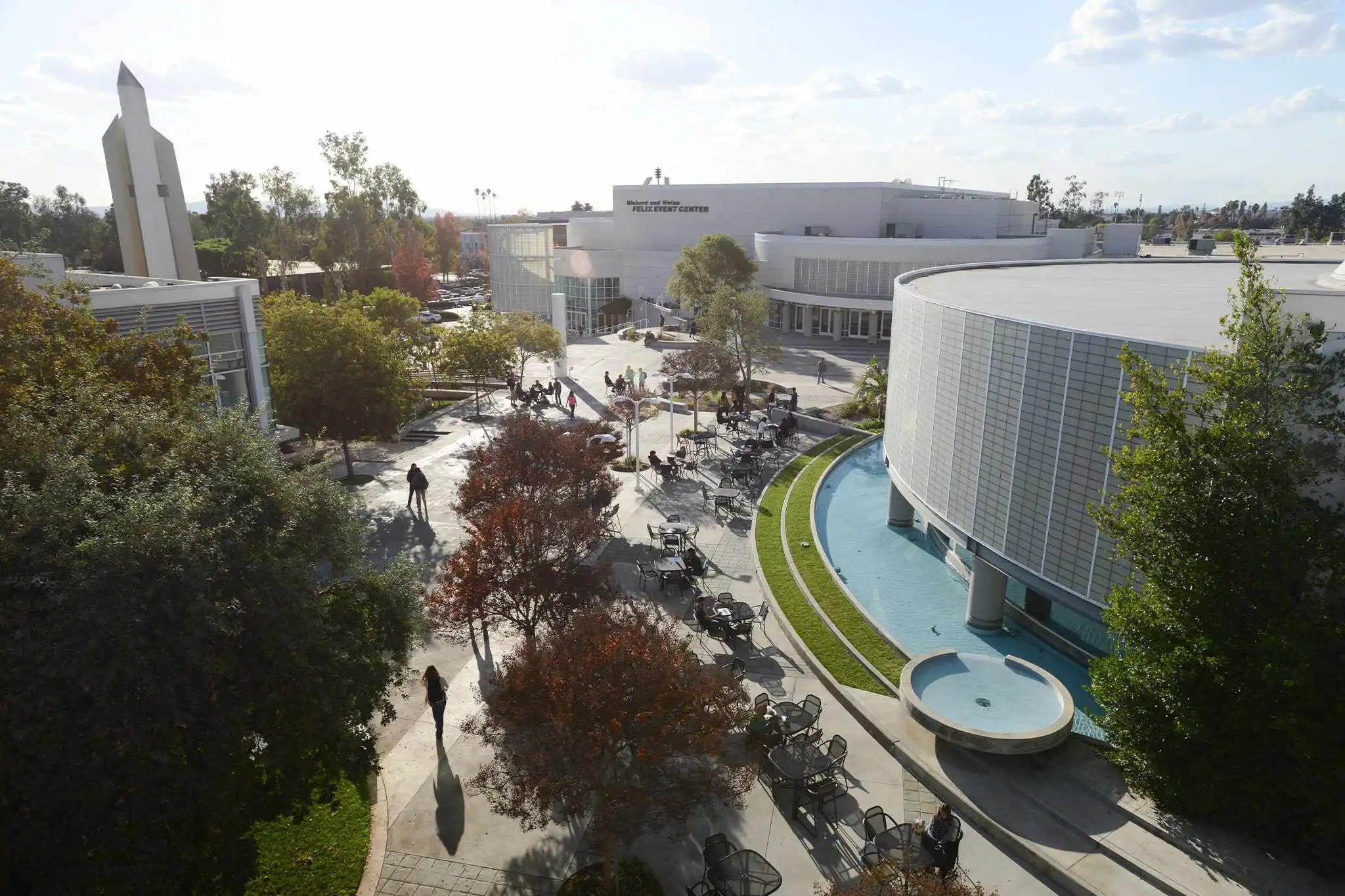
A Faith and Learning Community
Mission-Driven Community
Selecting the right college represents a significant decision for all students. Making that choice encompasses many considerations, from degree offerings and faculty, to financial aid, research and service opportunities, the character of campus life, and even location. Students determine which schools best meet their educational goals and align with personal beliefs.
At Azusa Pacific, those who live and learn together are an integral part of the fabric of our Christ-centered university community. Shared values, mutual respect, and hospitality are cherished attributes that each member contributes to and works hard to safeguard. As a leader in Christian higher education, we do not take this responsibility lightly and remain grateful to be part of the educational landscape of the great state of California. Faith integration, student care, service, biblical grounding, and Christian tenets combine to form the essence of our mission-driven community.
Azusa Pacific University is an institution that is Christ-centered, with a deep commitment to academic excellence, a global Great Commission mindset, and a passion to touch the lives of our beloved and diverse student body.Adam J. Morris, PhD, president of Azusa Pacific University
Faith Integration
Since the university’s founding in 1899, APU has incorporated our religious beliefs into every aspect of university life. We are transparent about our God First approach to higher education and Christ-centered academic excellence as it reflects our mission-driven identity, including our commitment to diversity. All curricula across our academic disciplines integrate faith. In classrooms, residence halls, chapel, and discipleship groups, students discover their higher calling and witness His transformation. To uphold this distinction, APU employs faculty and staff who share the Christian faith across denominations.
Student Care
With Christ as our example, we seek to create space for dialogue and engagement that upholds our commitment to mutual respect. Should concerns arise, the university’s Student Belonging team comes alongside struggling students to offer assistance. We also offer a Bias Reporting System that empowers students and community members to make reports and seek recourse if an intentional or unintentional act or behavior occurs. That sets in motion a process of accountability, resolution, and reconciliation. In addition, the university’s Student Belonging division offers the campus ongoing education and resources that foster the kind of community we aspire to be. The university also provides grievance processes for students and employees to resolve disputes as they arise. Each day, the university community strives to create an environment where students and employees can flourish.

In high school, my only Christian friends were at church. When I came to APU, I discovered other Christian students and professors wanting to dive deep into conversations and community. I am able to make meaningful relationships with brothers and sisters in Christ—people I can pray with and go to in times of need.
discovered his calling to go into ministry and has grown his faith through APU’s Christian community. Read more of Charlie’s story.
Service
- 28,360 service-learning hours
- 102 chapel services each year
- 34 mission teams sent to 20 countries
We believe love and creativity changes oppressive minds and systems. When people create, they can embody justice, beauty, and hope. Music and the arts provide a powerful avenue for healing, restoration, and empowerment. We’re giving students channels of connection where they can realize their potential and have a better future. I catch a glimpse of the story God is weaving, and I love seeing how God’s love changes people’s hearts and lives.Eileen O’Neall ’12
built a nonprofit in the Himalayas and Southeast Asia dedicated to helping restoration from human trafficking. Creative Hope International offers musical, dance, and artistic training. Read more of Eileen’s story.
Diversity
- 68% of APU’s more than 7,000 students are ethnically diverse
- 813 of the more than 3,000 undergraduates receive Cal Grants
- 79.6% of Cal Grant recipients come from underserved families
- 61.3% six-year graduation rate
- 1 of 117 Hispanic-serving institutions in California
- 1 of 19 AAPI-serving institutions in California
Thanks to my Master of Social Work classes at APU, I came up with the idea for Shoes4Grades, a nonprofit dedicated to motivating kids to do well academically and to developing a lifelong love of learning. If you can get a good education, you can break the cycle of poverty and set an example for the next generation to follow.Randall Trice ’19, MSW ’20
has donated more than 2,000 pairs of shoes to foster youth in Southern California and beyond. Read more of Randall’s story.
Religious Expression
The precious freedom to express our religious tenets is recognized by the United States and California Constitutions and honored by the U.S. Department of Education. Other federal and state laws likewise support the opportunity for Azusa Pacific and other religious higher education institutions to weave religious beliefs into all aspects of university life. For example, exemptions in Title IX1 and the California Equity in Higher Education Act2 support Azusa Pacific’s efforts to operate consistently with its religious tenets by maintaining biblical standards of behaviors that all community members voluntarily agree to follow as a condition of living and learning in our community. These laws protect the rights of Azusa Pacific and other religious institutions with the discretion to thoughtfully make policies and build community expectations around our mission to advance the work of God in the world through academic excellence and to help students develop a Christian perspective on truth and life. A full statement of APU’s mission and community expectations for faculty, staff, and students can be found at:
- What We Believe
- Undergraduate Student Handbook
- Graduate and Professional Student Community Expectations
- Residential Student Policies
- Employee and Faculty Handbooks (current employees only)
My parents came here to give a better life to their children. Graduating from college is what they dreamed of for my sister and I—we’re their living wish. I may be the first in my family to graduate from college, but I certainly won’t be the last.Eimee Ponciano ’24
was able to come to APU because of financial aid from the GEN1 Scholars program and guidance from her mentor in the TRIO program. She has served as an Alpha leader and a resident advisor at APU. Read more of Eimee’s story.
For more information or a hard copy of the Faith and Learning brochure, download the PDF below or contact the relevant office with your mailing address:
Admissions | (626) 815-2020
Human Resources | (626) 815-4527
Los Angeles Pacific University | (855) 527-2768
Download the Faith and Learning Brochure
Footnotes