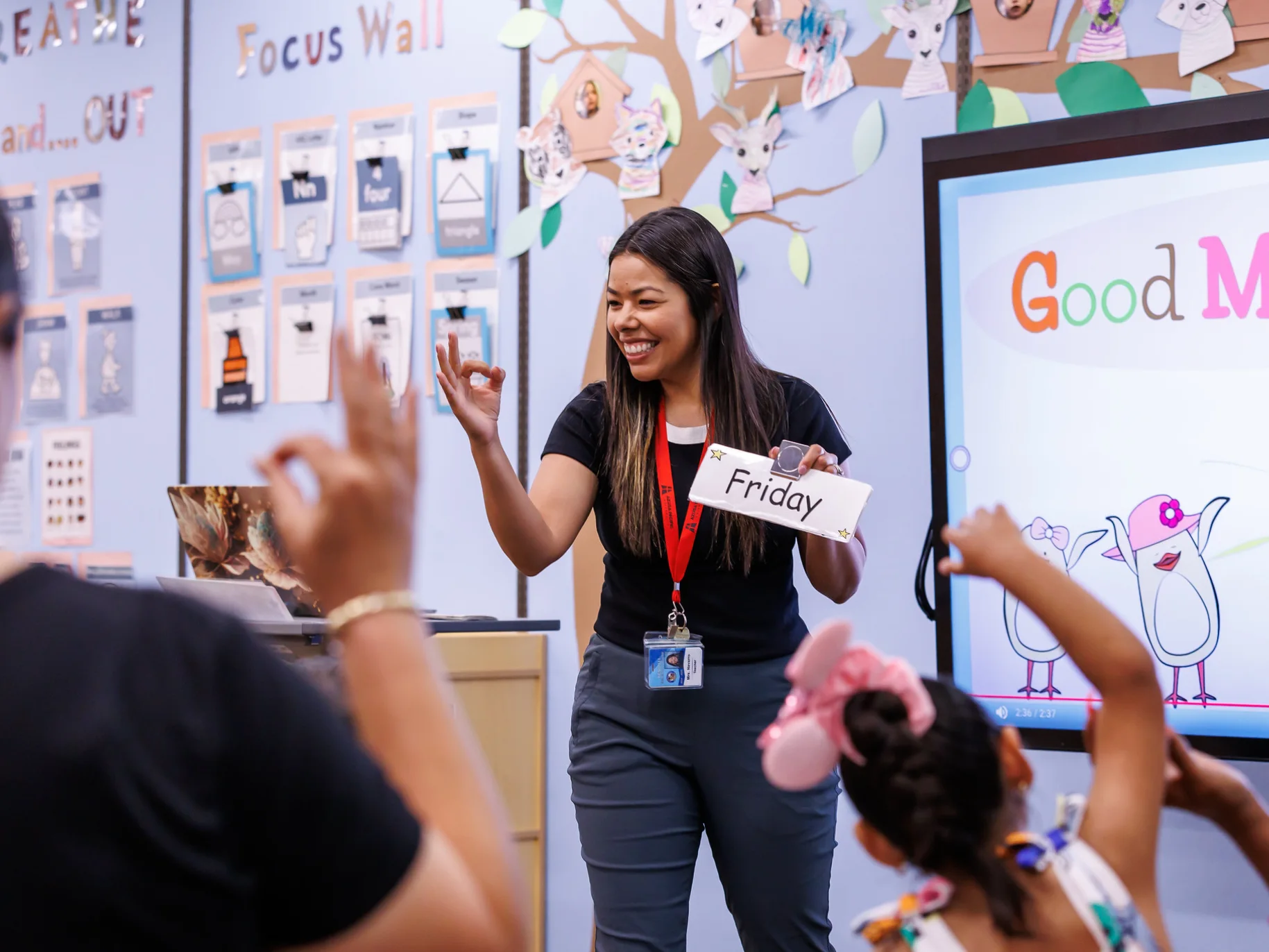
Diana Navarro, MA ’24, stood outside in the crisp morning air, watching her students run around the playground during recess at Kendall Elementary School in San Bernardino. What she observed gave her pause. In the classroom, her students with disabilities and those without interacted easily, participating together in inclusive activities with joy. However, on the playground, there was a major disconnect between the groups of students. “During those unstructured times like recess and lunch, our kids were not interacting genuinely with each other. It’s like they’d forgotten the friendships we see in the classroom,” Navarro said. “I knew there had to be something more we could do.”
For Navarro, time on the playground reminded her of her roots. Growing up in the Inland Empire, she fell in love with sports, playing baseball, basketball, football, and soccer with her brothers. “In my childhood, there was a lot of trauma, but sports were a refuge for me,” she said. “They helped me grow in my confidence, not just in my athletic abilities, but in team and relationship building too.” Although she excelled in a variety of sports, Navarro realized she wouldn’t become a professional athlete. She earned her undergraduate degree in psychology from Cal State San Bernardino before earning her education specialist credential at the moderate-to-extensive level.
After graduating in 2009 and earning her credential in 2011, Navarro became a special
education teacher at Kendall. Over the past 14 years, she’s taught every level from
kindergarten through fifth grade. “Being an educator is so rewarding,” she said. “My
favorite part of my job is seeing my kids show me their skills in a variety of new
ways that I never expected.” By way of example, Navarro shared about a nonverbal autistic
student who she was told was unable to read. Navarro had read books with the student
and asked her questions that she couldn’t answer. Then one day, Navarro played a reading
game with pictures on her classroom’s smart TV, and the student answered every question
correctly. “That blew me away! I called her mom and said, ‘She knows how to read!’”
Navarro said. “She knew more than we gave her credit for, and I only tapped into a
small portion of it.”
While Navarro loves her job, she began to feel called to something new in 2022. She decided to pursue a Master of Arts in Physical Education with an adapted physical education (APE) added authorization at Azusa Pacific University. “I wanted to pursue a subject where I was still going to serve the special education student population,” she said. “In my 14 years of classroom teaching, I always found ways to provide inclusion opportunities for all students on campus. That’s when I saw my students interacting with their peers the most. Physical education is a common language for all students.” Navarro was grateful for the program’s flexibility, with a hybrid schedule of online classes and bi-monthly full-day in-person sessions. She enjoyed the in-person days the most, collaborating with other graduate students who are working professionals and discussing how they were applying what they learned in their classes at their school sites. “I had so many amazing professors at APU. Although I had a lot of background knowledge and experience working with students in special education, they showed me so many new ways I can tailor and modify my instruction to meet the needs of my students using the universal design for learning,” Navarro said. “APU definitely equipped me to set my students up for success so they can truly be a part of their community.”
After two years in the program, Navarro began working on her capstone project, which
was advised by Angela Robles, EdD, associate professor. As she thought about a topic for her capstone, Navarro’s
mind went back to that day on the playground and the disconnect she noticed. She decided
to conduct research examining non-instructional interactions between students with
and without disabilities, including investigating what was happening at her own school.
“I see my kids and know they want to participate, to play with others and build friendships
during recess, but they don’t know how,” she said. “As educators, we have a responsibility
and opportunity to positively influence our kids, encouraging them to interact with
each other, inviting everyone to join in.” Navarro’s research suggested that the inclusive
policies currently in place are beneficial, but need to extend beyond just academic
curriculum, since socialization plays an equally vital role in children’s development.
Navarro hopes the data gathered from her study could help school administrators improve
climate and culture on their campuses.
Navarro was awarded the program’s Distinguished Capstone Award for the top paper in her cohort, an honor she never expected but was grateful to receive, knowing that others saw value in her research. “Our students are often an overlooked population. When I received the award, it was nice to see them get recognition through my work. It’s for them,” she said.
Inspired by her research, Navarro decided to start a social club for students with and without disabilities at her school. The club, nicknamed the Unified Cubroos (a combination of the school’s mascots), promotes awareness of the importance of inclusion outside of the classroom, and Navarro said it’s working. Gen ed students are showing respect for students with disabilities, and all the students are participating in games on the playground together. “It’s been awesome to watch our kids show leadership and invite others in, creating the beginning of long-lasting friendships,” she said.
Navarro noticed a big need that the club and the school’s PE program faced: a lack
of funding for new equipment. She applied for Kendall to become a Special Olympics Unified Champion School®. The application was accepted, and Navarro received generous funds from the Special
Olympics to buy games, sports equipment, books, and incentives to encourage student
participation, as well as to offer fun ways for students to interact positively. She
also received a large flag, T-shirts, and wristbands for her club to promote awareness
and get more students involved. “Getting funding is always a challenge, so I’m so
grateful for the resources this gift will provide,” she said.
As she wrapped up her time at Kendall Elementary, Navarro stepped into an exciting new chapter as an adult transition teacher at Milor High School. There, she continues putting what she learned in APU’s Adapted Physical Education program into practice—equipping young adults with disabilities to develop vital life skills, confidence, and community connections. Navarro's faith remains the cornerstone of her daily work. “I can't get out of bed without talking to God. Spending quiet time in prayer and meditation with Him gives me the strength I need each day,” Navarro said. She lives out her faith by treating others with lovingkindness and respect, leading with integrity, and advocating for her students—grateful to have found her God-given calling to impact the next generation.