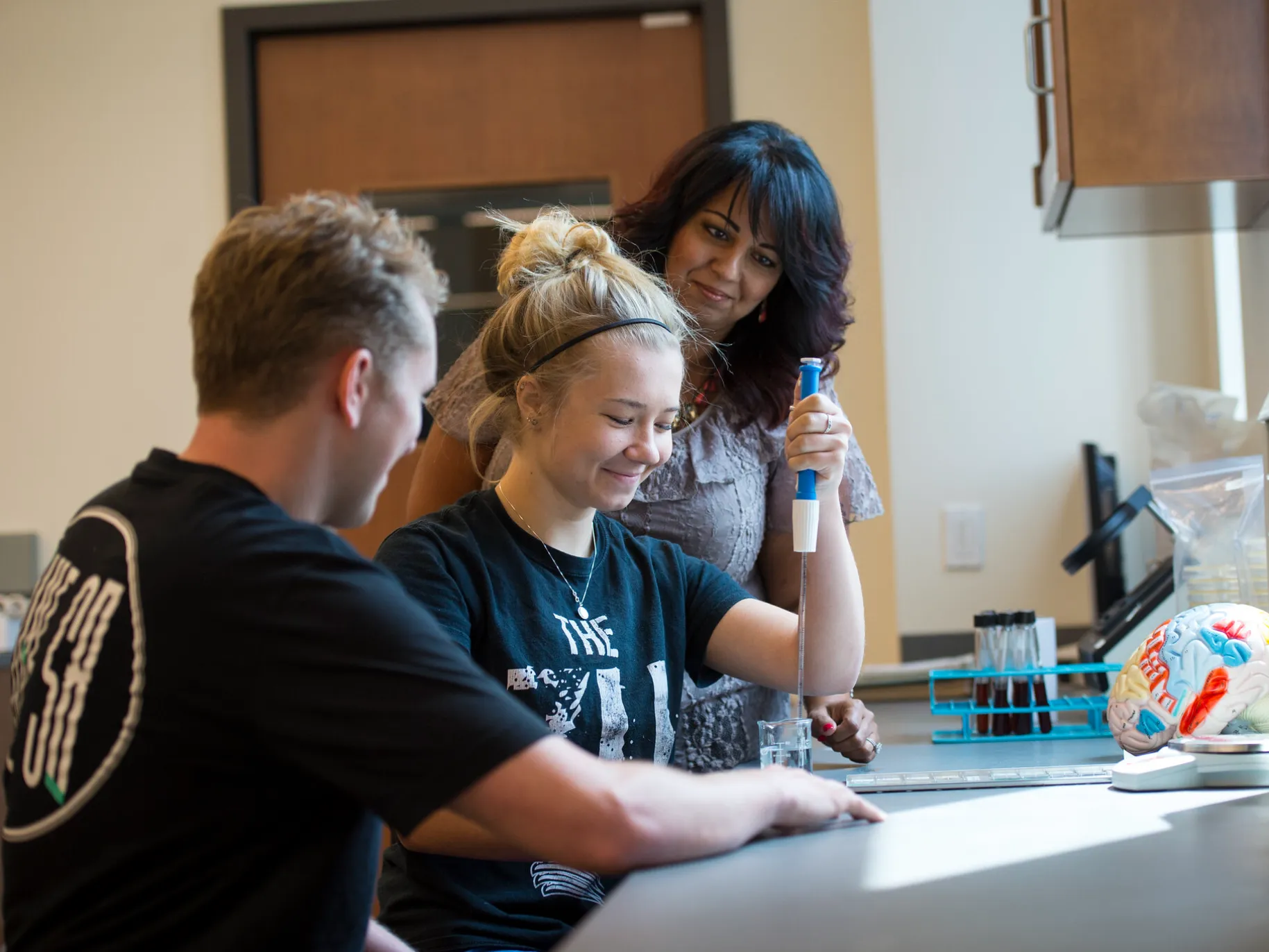
The biological sciences (BS) program at Azusa Pacific University provides individuals with a foundational understanding of biology and associated life science disciplines. With hands-on learning, mentorship, and the integration of faith, students are prepared to succeed in professions that span healthcare, biotechnology, conservation, and scientific research. For students who are interested in becoming doctors, dentists, or veterinarians, APU’s biological sciences program offers a well-rounded academic and professional preparation for admission to the top graduate schools around the country.
APU’s biological sciences program's foundation rests on the value of learning through practice. This is accomplished through laboratory-based classwork and faculty guided research projects, using sophisticated equipment that allows students to gain practical knowledge which students at most universities don’t receive during undergraduate studies. Charles Chen, PhD, professor in the Department of Biology and Chemistry, is excited by the prospective opportunities students have in the program. “Students gain practical skills through hands-on learning in lab classes, receive personalized mentoring by caring faculty, and conduct independent research projects utilizing top-class instruments,” said Chen. “These types of experiences may be few and far between at larger schools, but they are available to every student here in our department.”
Additionally, APU’s biological sciences program extends beyond technical skills. Jennifer Young, PhD, chair and professor in the Department of Biology and Chemistry, emphasized the breadth of the areas that students are taught when majoring in biological sciences, including molecular, cell, organismal, and ecological biology. “We provide a strong science foundation and an opportunity for students to really develop their scientific-thinking, critical-thinking skills, and lab skills,” said Young. “These experiences and learning opportunities teach students to solve problems they’ll encounter in their profession and to apply what they’re learning in real-world scenarios.”
The university's dedication to incorporating faith throughout learning is exemplified through the sciences. “One of the main things that differentiates our program is faith integration. Everything we do is done with a Christian worldview and perspective,” said Young. “It is not just something we say. We genuinely teach it in all of our classes.” Biology is a way to understand God’s creation better. Sarah Richart, PhD, professor in the Department of Biology and Chemistry, emphasized that a deeper pursuit of science is an exploration of God’s creation, and the two cannot be separated.
This perspective also shapes how students understand their place within the world. “We can see that interconnectedness between God’s creation, whether it be humans, plants, animals, or microorganisms, and see the beauty in that,” said Young. Richart echoed this idea, emphasizing humility and responsibility. “Biology reminds us that we are deeply dependent on other living things,” she said. “We are not separate from creation. We are embedded in it, and that should shape both our humility and our sense of responsibility.”
The program’s small class sizes enable meaningful relationships between students and faculty, creating an environment where mentorship thrives. “Because our classes are small, faculty know every student by name,” said Richart. “That creates space for real mentorship academically, personally, and spiritually.” Students also receive individualized academic advising directly from faculty. “Our students have the opportunity to advise directly with a faculty member in the program, which isn’t common at other schools,” said Young. “This allows us to care holistically for each student.”
Research is another core element of APU’s program, which offers undergraduates opportunities to discover new ideas and share their research findings with the scientific community through presentations and publications. “Students get the incredible opportunity to do research alongside a faculty member, learning their processes and working on projects that very few undergraduates have the chance to work on,” said Young. These experiences help students gain confidence and independence as they get ready for future endeavors. Aidan Oslob ’26 described how research shaped his education. “One of the most impactful aspects of my program has been the research, where I learned to adapt protocols from literature and became comfortable working independently,” said Oslob. “The program has also provided great assistance in preparing me for medical school through the pre-med track.” Oslob is one of many students who have received invaluable training and mentorship from APU’s biological sciences faculty, preparing them for an impactful career in the industry.
Debbie Hussey ’18 is living out her calling as a cancer researcher at City of Hope, one of the top cancer research and treatment centers in the country. As she is currently finishing her doctorate, she reflected on how APU’s program prepared her for this impactful career.
APU’s biological sciences program gave me individualized mentorship thanks to small classes and professors who were genuinely interested in my growth and success.Debbie Hussey '18
“I was able to gain extensive hands-on experience through designing experiments, writing grants, and carrying out research projects, which most students don’t encounter until graduate school.” These opportunities strengthened Hussey’s readiness for advanced study and a career in cancer research.
According to Richart, students must possess a strong work ethic to succeed in a rigorous program like biological sciences. “Students who thrive in our program are curious about God’s creatures and creation, how things work, enjoy problem-solving, and are willing to experiment not only in the lab, but in how they learn and think,” Richart said. In these ways, the biological sciences program challenges students to engage deeply with scientific concepts which prepares them well for graduate school in medicine, biotechnology, or environmental sciences.
Beyond academic preparation, the program challenges students to think critically about the ethical implications of scientific advancement. “There isn’t always one perfect answer to every ethical question,” said Richart. “Part of our role is helping students think critically, engage different perspectives, and develop thoughtful faith-based frameworks for decision-making.” Chen emphasized the importance of this approach in today’s world. “Here at APU, we teach not only the science of living things, but also challenge students to consider the responsible and ethical use of medicine and technology in the context of the Christian worldview,” he said.
Ultimately, the program seeks to prepare students for lives of meaningful contribution. “Our goal is not just to teach content, but to equip students with the tools to think deeply about science, faith, and the complex challenges they’ll face in their careers,” said Richart. Students are encouraged to see their passions as pathways to purpose. “We want students to see that their passions matter,” she added. “The things they love can point toward their calling, and there are many ways to use biology to serve others.” Cahleen Shrier, PhD, professor in the Department of Biology and Chemistry, loves the connection she shares with students as she celebrates where their journeys will lead them. “Every year, our office whiteboard transforms into a testament to excellence. Students' names are listed alongside the prestigious graduate schools into which they have been accepted and the career placements they have secured,” said Shrier. “It is a celebration of hard work, ambition, and the incredible professional journeys that begin right here.”