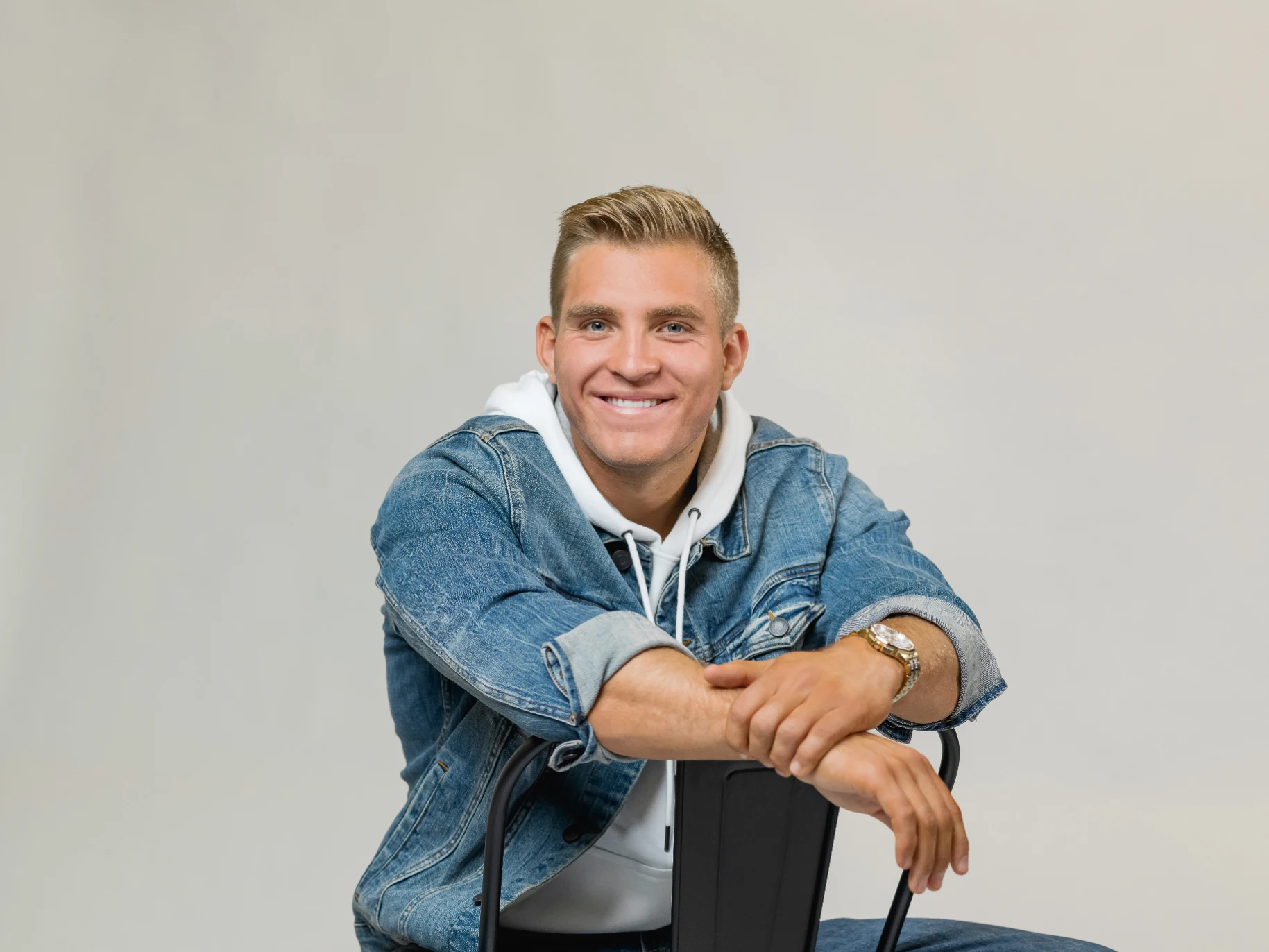
Austin Kramer ’22 is a man of many hats. At just 26-years-old, the Azusa Pacific University alumnus is the founder of the digital kiosk network HealthGoGo, executive producer of acquisitions for Redwood Studios, and serves as a business consultant for Beverly Hills Disc and Laser Therapy Center. While his entrepreneurial portfolio is quite expansive, Kramer’s journey to success was marked by overcoming adversity through innovation and collaboration with other entrepreneurs. Through several pivotal challenges, Kramer leaned on his faith to persevere and emerged on the other end ready to make an impact in the Los Angeles community.
Pivoting from Athletics to Business
Originally from Central Point, Oregon, Kramer grew up dreaming of moving to a big city. He got the opportunity after graduating from high school when he moved to Southern California for college. Kramer played football at Golden West College for two years before receiving an offer to play at APU. However, just a few months into his time as an APU student, the university announced it was closing its football program. “It hurt when I found out about football being canceled. That was the main reason I had come to APU, and I had just signed a lease in Azusa. It was really unfortunate, but it’s part of my story and it led me to where I am now,” he said. Although he continued to be recruited by NCAA Division I football programs across the country, Kramer decided to stay at APU to build credibility and a network in Los Angeles. He knew that having a degree from APU would carry weight as he ventured into the business world. A business management major, Kramer was determined to succeed academically. While he missed football, not having to practice and participate in team activities gave him far more time to dedicate to his studies and budding entrepreneurial ventures. Kramer’s resilience in the face of adversity earned him the School of Business and Management’s Most Outstanding Student award.
Kramer always had a knack for entrepreneurship. He decided to go into real estate and got his license before graduating from APU, landing a job with the Aaron Kirman Group, one of the largest real estate organizations in the country. He soon learned that one of the biggest challenges in real estate was awareness. “I made business cards with my face and a QR code on them and got them placed at several local businesses, hoping that would lead me to get clients,” he said. “While I did end up selling one house from placing my card, I quickly realized that it wouldn’t be sustainable long term. This experience taught me that awareness is everything in business, which eventually led me to realize the power of digital screens in high-traffic areas. I knew I had to pivot, but I didn’t know how.”
Then, on a spring day in 2023, Kramer was summoned for jury duty. He went to the courthouse in downtown LA, and while he was waiting to go into the courtroom, he saw a sign. “It was a screen that said ‘Advertise here,’ and right beneath it was a singular sanitizer post. It caused me to wonder: What if the sanitizer didn’t cost the businesses anything? What if advertising paid for it instead?” Kramer said. “That’s where the idea for Health Link Media was born.” Although the Covid-19 pandemic had mostly subsided by that point, people were still very cognizant of the dangers of the virus and were using sanitizer frequently to clean their hands and stay safe. There were now countless sanitizer dispensers across the country, particularly in heavily populated cities like LA. “What most people don’t realize is that companies have to pay for that sanitizer. It’s part of their overhead cost, and for certain businesses like convenience stores with thousands of locations, that cost really adds up,” he said.
Kramer began researching and found a manufacturer in China that created devices which would accomplish what he wanted. He ordered his first 10 devices and began approaching local businesses. Over the next two years, Kramer successfully placed more than 400 of his devices across LA, mostly in convenience stores. “It was a huge benefit for the community because it kept them clean and safe, and a bigger benefit for store owners because I was saving them around $100 a month in sanitizer costs at each location,” he said. However, Kramer realized his business model wouldn’t become profitable at its current scale. The major companies he was looking to run ads for didn’t want 400 screens, they wanted 4,000 or more. Kramer would have to invest a significant amount more than he already had in his company to get to the scale he needed to sell ads, and that meant he’d need to fundraise quite a bit before he would begin turning tangible profits. “It was all adding up, so I thought, what if I joined someone else’s network and we integrated?”
Kramer reached out to June Zhu, the CEO and founder of Charger GoGo, the largest on-the-go charging network in the U.S. to begin discussing a partnership. Charger GoGo already had screens in more than 6,000 locations including large stadiums and arenas and at top companies across the country, and Zhu owned the software and was able to get the best pricing from Chinese manufacturers because she was already doing it at a large scale. “June created something amazing in Charger GoGo,” Kramer said. “I’m a big believer in teamwork and collaboration. A big thing APU taught me is the idea of going faster alone but going farther together. The partnership with June made total sense and I’m really excited for where we’re headed.” Kramer strategized with his brother, Cameron, who had been running the digital back end of the platform with a strong marketing strategy and brand development all while finishing his degree at San Diego State University, about the future of their company. They decided to move forward with Zhu’s company, rebranding Health Link Media as HealthGoGo, the flagship vertical for the ChargerGoGo network. Together with Zhu’s company, they are launching new kiosks with sanitizer, portable chargers, and digital advertising screens, an innovative 3-in-1 platform which will one day be available across the country, starting at a place near and dear to Kramer, his alma mater. HealthGogo is preparing for a rollout on the APU campus, with installations beginning before summer, and a full launch for students by the Fall 2026 semester.
Side Hustles and Impact
When he’s not working on expanding HealthGoGo, Kramer is dedicating his time to his other work. In his role as executive producer of acquisitions for Redwood Studios, Kramer oversees content procurement, reviewing independent films and TV shows and helping them land on streaming platforms including Netflix, HBO Max, and Amazon Prime. “With Redwood Studios, I got lucky. After meeting the right people, they gave me an opportunity and I proved myself to them by working my butt off,” he said. “I enjoy it because I’m a kind of gatekeeper, helping decide what content is being pushed onto these streaming platforms.”
Kramer also began another endeavor as a business consultant for Beverly Hills Disc and Laser Therapy Center. Run by Bryan Abasolo, a celebrity chiropractor known for winning season 13 of The Bachelorette, Kramer helps run the center’s marketing and Abasolo’s social media. “During Covid, I received several opportunities as a background actor for shows like All American and Bel Air. I became friends with some famous actors and posted photos with them on my Instagram,” he said. “That led me to grow my own following pretty substantially. After a while, I realized I was pretty good at social media and Cameron and I decided to offer our services as social media consultants. Since then, working with stars like Bryan and Jax Taylor on their social media has been great.” Kramer is also helping Abasolo open another location, a wellness clinic with red light therapy, hot and cold saunas, and IV therapy in Beverly Hills, set to open later this year.
While his three jobs don’t have much in common on the surface, they’re all driven by Kramer’s desire to help others and create a positive impact in LA. As an entrepreneur, Kramer looks up to other accomplished businessmen like Rick Caruso, the billionaire philanthropist known for owning beautiful outdoor malls like The Americana in Glendale and The Grove in LA. “Rick created something that has impact, places where families enjoy spending time together. It’s people like that who I want to emulate,” he said. Kramer views these kiosks as a form of digital infrastructure that, like Caruso’s developments, improves the everyday lives and utility of public spaces in LA. “I want to create something that impacts others, to help shape a brighter future for LA. I love this city and while it has its flaws, it’s a beautiful, diverse community where you can succeed at anything if you put your mind to it. Ten years from now, I want to have built something that’s made life better for fellow Angelenos and beyond,” he said.
A major part of Kramer’s story is his faith. Six years ago, Kramer faced one of the toughest situations in his life, as he questioned where his identity lay now that his football career was over. “I had a lot of questioning of ‘Why God? Why are things happening the way they are?’” Kramer said. “Through my faith, I trust His process. I recognize that I can’t see what He can see. I don’t know what tomorrow holds, but I know it’s all a part of God’s plan. I’m just doing my best to be faithful and to do everything in the right, ethical way. I know that when I lean on God, anything is possible.”