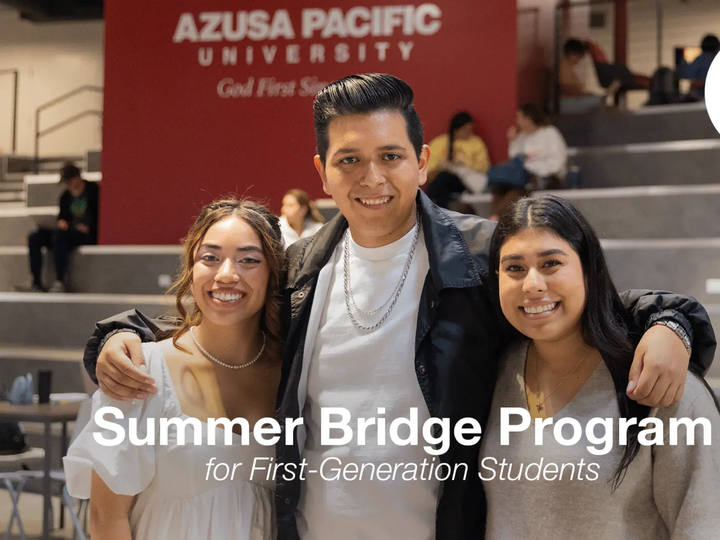
Starting college can be a daunting endeavor for many incoming freshmen. Entering a new environment, living away from home, and taking new classes can feel like a lot, especially for first-generation students. For students starting at Azusa Pacific University, the Summer Bridge program helps alleviate those fears. The five-week program allows students to live on campus, take classes, and learn more about their new home. This upcoming summer offers students pursuing majors in science, technology, engineering, and mathematics (STEM) the chance to take classes uniquely designed for them.
Easing the Transition for First-Generation Students
This program is a unique opportunity for students to gain experience on a college campus without the added pressure of starting the semester off. “Students can develop community and gain a new perspective about college,” said Rochelle Woods, Ed.D, director of the Summer Bridge program. “Many students are the first in their families to attend college, so they don’t necessarily know what to expect. This is a chance for them to understand what college life is like.” Giving students the chance to live on campus allows them to build community with each other, and establish independence. “Living on campus was an amazing experience,” said Isabella Cucinella ’29. “I was able to meet other freshmen and transition into the school year well.”
Building a Academic Foundation for STEM Success
With the implementation of new STEM classes, students are able to get ahead on the content for their major, while learning how to access the resources that APU has to offer. “We are building a foundation for these students to grow from. We give them the fundamentals for upper division courses, and understanding the rigor of college classes,” said Nilo Tayag, MA ’24, Writing Center program manager. With classes like Ethnic Studies and Intermediate Algebra, students can gain the skills they need to succeed in their major. Learning the expectations of college assignments can help quell the anxieties of entering college. Students also learn how to use resources like the Writing and Tutoring Center and office hours throughout the program, allowing them to know how to use those resources when the school semester starts.
As students grow more acclimated to the campus, they can connect with their peers, professors, and community members. First-generation college students can gain the insight and understanding that they didn’t have access to before. “These students are getting an experience that no one else in their family has had,” said Tayag. “That can be daunting, but we are here to help ease the transition and set them up for success.” As a first-generation student, Cucinella appreciated the extra time on campus.
These students are getting an experience that no one else in their family has had,Isabella Cucinella
Integrating Faith and Scholarship from Day One
One essential part of any APU class is faith integration. With classes that focus on ethics, writing, math, and other subjects, each professor has a unique approach to how they integrate faith into their content. “We bring in speakers to share with students, in addition to the work that professors do with their students,” said Woods. Faith integration includes conversations about how to approach writing or math as a Christian, larger projects, and how to be a student who continues to put Christ at the center of scholarship. “We work on what we believe, and why we believe, and how we could let that influence our writing. Faith integration is something that naturally develops through the class process,” said Tayag. Students in the Summer Bridge program are able to get a grasp on what faith integration looks like in the classrooms and have deep faith-based discussions with their fellow students. These conversations can lead to deeper connections and friendships amongst students in the program.
Mentorship That Lasts Beyond the Summer
While starting college can seem daunting, APU aims to make that process as welcoming as possible. The work of faculty and staff in the Summer Bridge program helps to provide students with a smooth transition into college life, with amazing opportunities to connect with students, establish independence, and expand their understanding. “I love the chance to mentor these students,” said Tayag. “That support goes beyond the couple of weeks of the program; it lasts throughout their four years at college.” The valuable time that students receive within the program supplies them with the skills and knowledge they need to grow exponentially throughout the rest of their college careers.
Apply to APU, California’s Top Ranked Christian University
Frequently Asked Questions (FAQ)
The Summer Bridge program at Azusa Pacific University is a five-week program that allows incoming freshmen, especially first-generation students, to live on campus, take classes, and acclimate to college life before the fall semester begins.
The program now includes STEM-specific classes designed to give students the fundamentals for upper-division courses and help them understand the rigor of science, technology, engineering, and mathematics subjects.
Yes. Faith integration is a core component, where students and professors discuss how to approach subjects like math and writing through a Christian worldview, often featuring guest speakers and deep faith-based discussions.