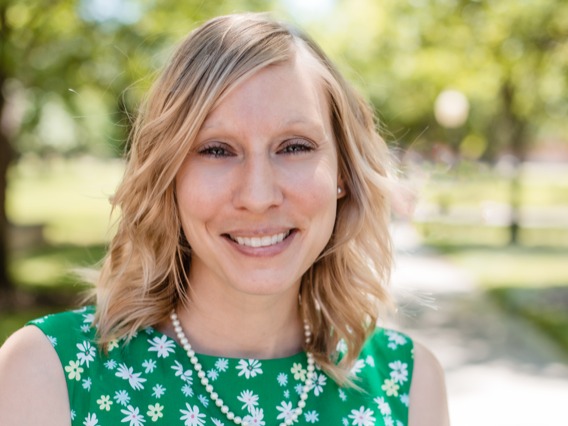
Reading and thinking deeply about literature and theology are essential to developing well-rounded scholars. This is what Azusa Pacific University alumna Rachel Griffis ’06 is trying to teach through her book Deep Reading: Practices to Subvert the Vices of Our Distracted, Hostile, and Consumeristic Age, which won the 2025 Arlin G. Meyer Book Award. Griffis is teaching the next generation of believers how to actively engage in their reading and be better voices for the Kingdom.
Griffis serves as an associate professor of English at Spring Arbor University in Michigan. “My love for teaching literature really started at APU. Having that Christian perspective on education showed me how my faith and my studies were intertwined,” said Griffis. “Faith gave me a unique insight into my studies, and everything I learned strengthened my faith.” She specializes in American literature, renowned author Cormac McCarthy, and the Christian literary tradition. “Being a scholar helps me so much with my teaching—they feed into each other,” she said. “There are times in the semester when I feel like I am just a professor, because I am focusing on my classes and new students. In the middle of the semester, I can focus on research and being a scholar as well as my teaching.”
Griffis’ research has been published in multiple academic journals and books, and she has given talks about her scholarly research on McCarthy. “Where I really started to see McCarthy as my focus as a scholar was in my first job,” she said. “I taught him every semester, which gave me ideas for furthering my scholarship. I realized that this was who I should be focusing on in my research.”
In 2024, alongside authors Julie Ooms and Rachel M. De Smith Roberts, Griffis published Deep Reading. The book specifically focused on the vices that keep readers of the 21st century from interacting with the content they are reading and gaining understanding from it. “It is a book for teachers, readers, and other educators. Distraction, consumerism, and hostility bleed into their reading lives,” said Griffis. “Rather than being a deep reader who gets lost in great works, people are reading on a screen, clicking on rage bait, and getting riled up about things that are intended to evoke an emotional response. Those are the readers who are the most prevalent.” Using their shared experiences in the classroom and in the world of academia, Griffis and her fellow authors provide examples of how to realign students and help them dive deeper into their reading. “The chapters reflect all of us. We talked about how to teach subjects that are culturally insensitive in today's classroom, and we all had a different answer to how we would handle that situation,” said Griffis. “We had the opportunity to practice hospitality with each other.”
Deep reading is essential for Christian academics. “Reading literature, reading anything
that is well written, helps me to be a better Christian because it keeps my skills
sharp: being able to listen for nuance and pay attention,” said Griffis.
Through her book, Griffis is teaching the next generation of leaders how to better
understand Scripture and how to allow it to influence their lives for the better.
As a result, the book won the Arlin G. Meyer Book Award, an honor that highlights professors exemplifying faith and learning in the Christian tradition. “Getting this award from the Lilly Organization, which I am so thankful for and has so deeply informed me, was thrilling. I never would have imagined when I was entering my PhD program that I would be contributing something like that to the community,” said Griffis.
Griffis started her academic journey at APU, studying literature. Working with faculty like Emily Griesinger, PhD, professor emerita, Griffis found a passion for teaching and working within a Christian university. “I resonated with the way Dr. Griesinger taught. She always had the big picture in mind,” said Griffis. “She was also intentional about how she approached things as a Christian. It never felt superficial, but it really was a natural way of looking at literary traditions and human culture.” Griesinger’s mentorship helped Griffis apply to graduate schools, receive the Lilly Graduate Fellowship, and continues to provide support. “She helped me with the challenges in life, and brought her whole self, and made it a space where I could bring my whole self as well,” said Griffis.
APU was foundational in Griffis’ journey as an academic.
“I am so grateful that APU was a part of my story,” said Griffis. “The message of
APU was that there was no divide between your faith and your studies. Your faith is
a vibrant part of everything that you do, and that has helped me to see how faith
is foundational to everything else.” Through her time in undergrad, Griffis expanded
her faith and found her path to her current career. “I would tell any student to be
the best learner that they can be, and the rest will come. You will learn how to read,
write, and do research, and trust that your professors know how to guide you,” said
Griffis. “It is stressful to be a college student. I teach them every day. But there
is a lot of joy that comes from learning about God’s creations and the amazing things
that God’s creatures have created. Find a way to enjoy it.” Every day, Griffis is
working to help new generations enjoy the world that God has created and dig deep
to find meaning in every life and learning.