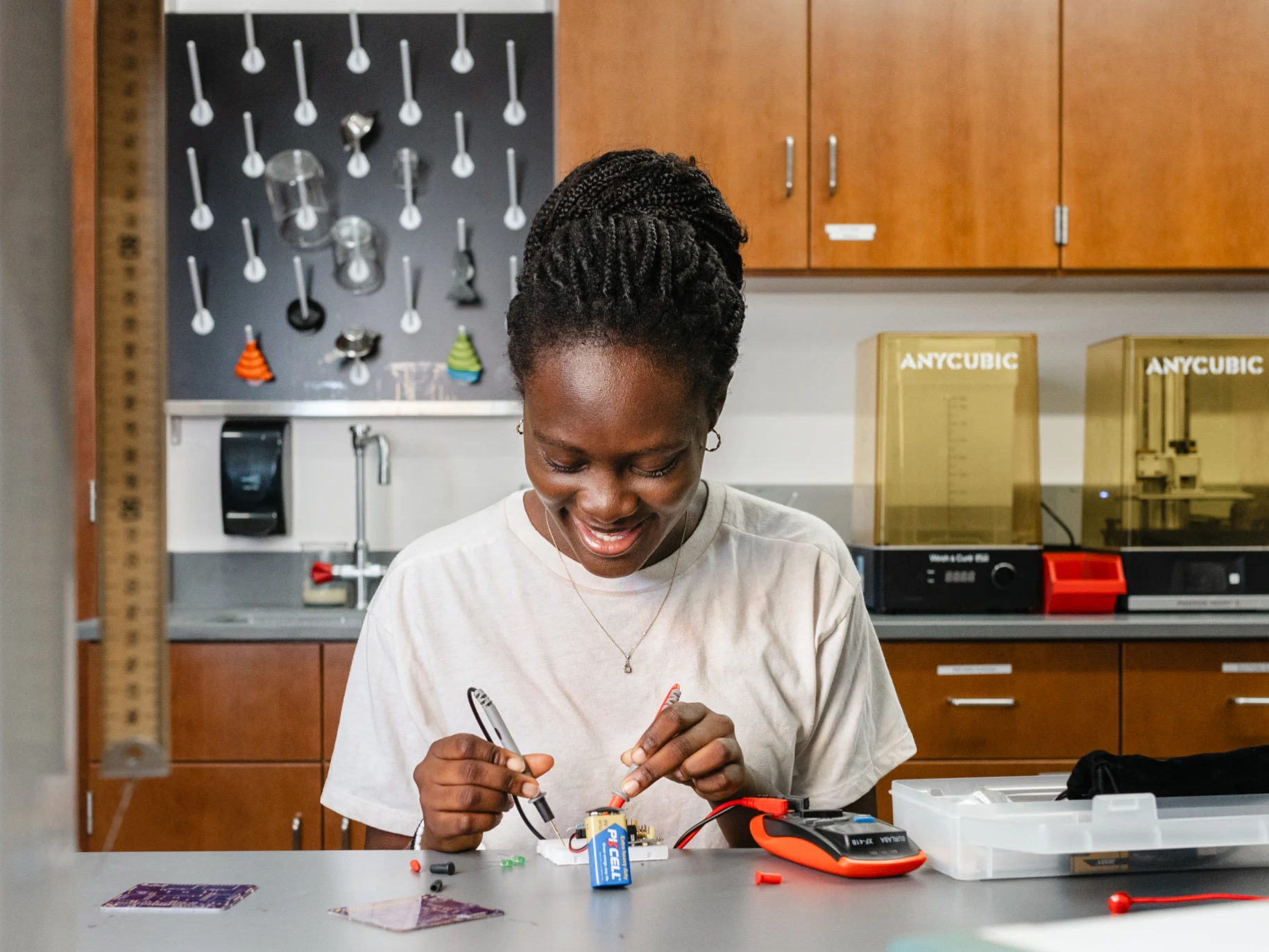
Engineering is a hands-on career path that requires not only hypothetical knowledge, but practical application skills. Azusa Pacific University’s engineering program prepares students for postgraduation success by exposing them to in-class and outside opportunities to work with the tools and materials of a professional engineer. Students can begin the program in both the traditional undergraduate fall and spring semesters, and classes are all offered in-person.
Students’ first year in the program is designed to build a foundation of math and physics knowledge along with general engineering principles. The second year allows students to dive deeper into engineering principles, mechanical composition, and electrical engineering based on their concentration. In this year, students decide if they want to pursue a concentration or earn a general engineering degree. In the third year, students who choose to pursue a concentration will take courses that reflect their choice, and the fourth year of the program consists of a senior design class and various electives.
Academically and Personally Invested Professors
With a 10:1 student to faculty ratio, students in the program receive lots of support and attention from their professors. Each faculty member is passionate about their own engineering concentration and wants to help students find their niche within the field as well. “APU’s program has professors that pay special attention to students not just when it comes to understanding their academic path, but with career planning and life questions,” Karina White ’22 said. “You won’t find such an intentional group of professors who are all skilled in their own ways within the field anywhere else.”
Engineering requires attention to detail and thorough understanding of complex topics, both of which are improved by the personal attention professors are able to provide students. White shared that associate professor Aisha Chen, PhD, was brilliant, kind, and a huge inspiration. “She taught courses that I was interested in, and when I wanted to learn more, she worked with me to do a follow up course another semester so that I could dig deeper into the content surrounding digital signal processing which helped me find my current job,” White said.
Faith Integration in STEM
Each program at APU intentionally integrates faith into their curriculum in a way that is meaningful to students in a personal and professional way. Faculty and students in the program believe that the faith integration aspect is what sets engineering at APU apart from other universities. “Faith integration looks vastly different in each course, but I have had many conversations with students each semester about how what we learn allows us to consider our career decisions based on our faith,” Chen said. “When we talk about ethical design, I share my belief that you can’t have a completely unbiased design, so we have to use our faith and experiences to create intentional designs for good.”
Professors keep APU’s God First motto in mind when creating a faith based curriculum that allows students to explore ethics, the evolving digital world, and how to communicate well with others. Upholding APU’s motto is especially important in STEM programs where it is common for people to assume that faith and science are not compatible. “Usually people who go into the sciences find it easier to keep God separate from their studies, but I love how APU embraces God as the creator and encourages us to study the sciences not just to pursue a high paying career, but to learn more about Him and His creations,” said Abigail Rojas ’26, a systems engineering major with a triple minor in computer science, math, and honors humanities.
White agreed that the professors in the program do an impactful job at integrating faith into the coursework and providing students with new perspectives even within the lens of their own Christian faith. “Engineering taught me to recognize the beauty of creation and the abundance of detail and genius behind God’s designs in the world,” White said.
Class Projects Enhance Workplace Confidence
A highlight of students’ time in the program is working with a group of peers on a senior design project, which is divided into two courses. In the fall semester, students come up with a unique idea for a project including its users, effects, environmental impact, societal impact, financial elements, potential business prosperity, power calculations, and component design. In the spring semester, groups build their product, conduct testing, and make any calculation changes to create their final product. White and her team built a ground station to connect GPS satellites. “My team and professors were so dedicated and professional in helping piece together this system,” she said. “When we finally tested it and had something tangible that we saw go from a concept to a reality that could collect the data we were looking for was such a proud moment. It’s the culmination of a lot of hard work and complex problem solving, and it gave me confidence moving into the workplace.”
Not only does the engineering program give students hands-on experience as engineers, they also learn to problem solve, think critically, and follow their own personal passions.
During her time in the program, Rojas used her knowledge and skills to solve a problem in her car. “I’m really proud of all the projects I have done,” she said. “In my electronics class, I made a Bluetooth radio transmitter that you can plug your phone into and transmit audio on a radio frequency. I made this because my car is older and is unable to connect to my phone, but I was able to transmit music from my phone using this project and then tuned my car radio into that channel to listen to my own music while driving!”
Opportunities For Mentorship
To further prepare students to enter the workforce, professors help students find opportunities to hone their skills outside of the classroom. There are two on-campus research projects led by professors that students get particularly excited to participate in. The first is a virtual reality (VR) study to see if music can help people’s ability to walk. Students help with data collection and building the VR environments. The second project focuses on movement with the help of a prosthetic foot. In this group, students designed a foot and are conducting testing to see how much weight it can support. “Students are learning to create VR simulations, learn data analysis in commonly used programs, use a 3D printer, and test their hypothesis which all benefits them as they enter the workplace,” Chen said.
White said that her professors were crucial in helping her find a job after graduation. In the classroom, they taught her the essential skills needed to be an engineer, but they also modeled the importance of thinking like an engineer. “They taught me that even if I run into something I don’t understand, there are resources and other pieces that exist somewhere to help me understand—I just have to find them,” she said. “They encouraged my curiosity which gave me confidence in my career.” With the help of her professors through mentorship and networking, White landed an engineering job just one week after graduation at L3Harris Technologies.
Another opportunity for students to put their knowledge into action is by joining the Robotics Club or the Society of Women Engineers (SWE). “I think one advantage of a smaller program is that community comes about more naturally than in a larger one,” Rojas said. “Outside of class, there are clubs like Robotics Club and SWE which foster community.” Professors also continue to offer mentorship and networking by hosting regular office hours and once-a-semester events such as dinner for all staff and students in the program.
Throughout the traditional four year program, students are encouraged to explore their faith, build upon their skills outside of the classroom, and use their personal passions to create useful, ethical products. The engineering program focuses on hands-on learning that prepares students to enter the workforce with not only the necessary knowledge to succeed, but the experience and critical thinking skills to thrive as professionals and followers of Christ.